Why Basirah
CTEM gets you to mobilization.
Basirah takes you to proof.
Exposure management frameworks stop at prioritization. Basirah closes the loop.
The category ladder
Three stages of vulnerability management maturity
Most organizations are stuck at stage one or two. Each stage solves a real problem, but leaves a critical gap.
Detection Tools
Find problems
Scanners, CSPM, dashboards
- Discover vulnerabilities across environments
- Surface misconfigurations and exposures
- Generate findings and alerts
Gap: Findings pile up. No ownership, no SLAs, no proof anything got fixed.
Prioritization Platforms
Rank problems
Risk scoring, triage engines, CVSS enrichment
- Score and rank findings by severity or exploitability
- Enrich with threat intelligence context
- Recommend what to fix first
Gap: Prioritized lists still land in spreadsheets. Closure is self-reported.
Proof & Quantification
Fix, verify, and prove
Basirah
- Quantify risk as P50/P95 annualized loss expectancy in dollars
- Verify remediation with independent re-scans (PASS/FAIL)
- Generate tamper-evident proof of remediation
- Govern remediation decisions with context-aware intelligence
- Enforce SLAs from finding to verified closure
No gap. Every fix is verified and quantified.
CTEM says prioritize. Basirah quantifies in dollars.
CTEM says validate. Basirah proves with independent verification.
CTEM says mobilize. Basirah governs, verifies, and seals.
The execution loop
Five steps from finding to sealed proof
From scanner telemetry to sealed evidence. Click a step to explore.
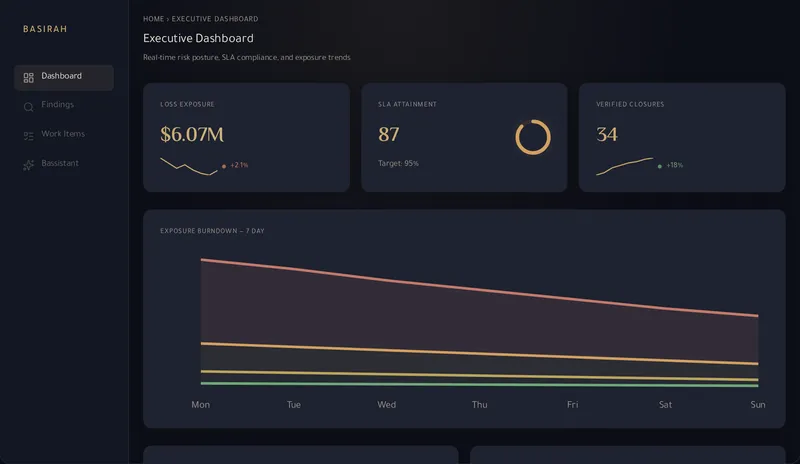
Turn telemetry into dollars
Normalize findings across your scanner stack. FAIR-based Monte Carlo simulation expresses exposure as P50/P95 annualized loss.
- Ingest + normalize + deduplicate
- FAIR risk quantification
- Prioritize by financial impact
What makes Basirah different
Five capabilities most remediation tools don't have
Basirah doesn't just add another layer of visibility. It changes what "done" means.
Risk in dollars
FAIR Monte Carlo simulation gives your board P50/P95 annualized loss they can act on. Financial impact replaces severity labels.
Intelligence that decides, not summarizes
Bassistant draws from live findings, compliance data, and org memory to propose actions with financial reasoning. Sensitive operations wait for approval. Operators stay in control.
Closed until proven
Findings stay open until independent re-scan returns PASS. SLA clocks run through verification.
Tamper-evident proof of remediation
Verified fixes produce sealed evidence with cryptographic integrity, timestamps, and control mappings. Export for any auditor.
SLA clocks that don't lie
Critical: 24h. High: 72h. Clocks start at finding, run through verification. Breaches escalate and log automatically.
Regulatory alignment
Aligned to mandates your auditors enforce
Basirah maps your controls to regional compliance mandates.
Regulatory summaries are informational and should be validated against current legal text and assessor guidance for your jurisdiction.
Select a region to explore its regulatory frameworks
Side-by-side comparison
Common approach vs. Cyber RiskOps
The difference isn't incremental. It's structural.
| Common Approach | Cyber RiskOps (Basirah) | |
|---|---|---|
| When is a finding "fixed"? | When someone closes the ticket | When an independent re-scan returns PASS |
| How is risk measured? | CVSS scores and severity labels | P50/P95 annualized loss expectancy in dollars |
| What does the auditor see? | Screenshots and spreadsheets compiled before the audit | Tamper-evident evidence packages with cryptographic integrity |
| Who owns remediation? | Implicit: whoever reads the dashboard | Explicit: assigned owner with SLA clock and escalation path |
| How does intelligence fit in? | Standalone chatbot alongside dashboards | Governed intelligence that decides, acts, and proves outcomes within the remediation workflow |
| What happens on SLA breach? | Nothing, or a monthly report mentions it | Automated escalation, breach logging, governance trail |
See the difference live
Bring a remediation scenario and see risk quantification, verification, and sealed evidence with your environment in mind.